Tooth pain has a way of showing up at the worst possible time. One day it’s a mild discomfort, the next day you can’t chew, sleep, or even think straight. When you finally visit a dentist, you often hear two options: root canal or tooth extraction.
And that’s when confusion kicks in.
“Which one is better?” “Will it hurt?” “Is removing the tooth the easier way out?” “Can the tooth still be saved?”
If you’ve ever asked these questions, you’re not alone. Let’s break this down in the simplest way possible so you can make a decision that actually feels right for you.
First things first: What are we trying to do?
The goal of any good dental treatment is to save your natural tooth whenever possible.
Your natural tooth is always better than any replacement—whether it’s a bridge, denture, or implant. It helps you chew properly, keeps your jaw strong, and maintains your natural smile.
That’s why dentists usually prefer a root canal over extraction; if the tooth can be saved.
What exactly is a root canal?
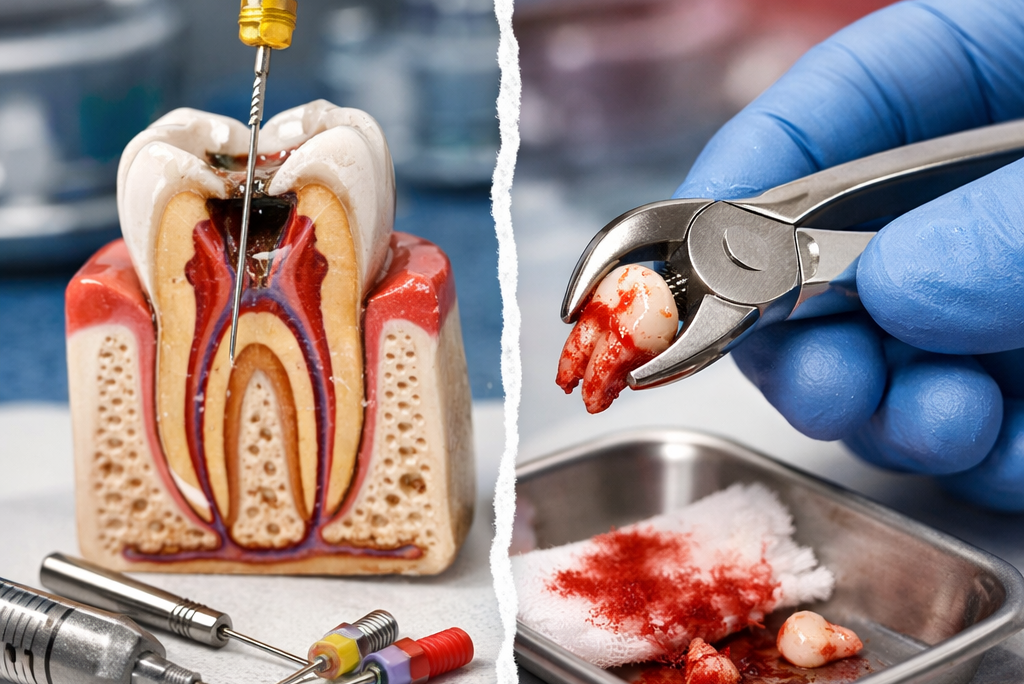
A root canal is done when the inside of your tooth gets infected. This can happen because of deep cavities, cracks, or old fillings that let bacteria enter.
In a root canal:
- The infected part inside the tooth is cleaned
- The pain-causing infection is removed
- The tooth is sealed and protected
- A cap (crown) is usually placed to make it strong again
The important thing to know is this: The tooth stays in your mouth.
At Smriti Raj Dentistry, root canal treatments are done using advanced technology that focuses on comfort and precision. Most patients are surprised by how easy the procedure feels compared to what they imagined.
When does tooth extraction make sense?
Tooth extraction means removing the tooth completely. While it sounds scary, sometimes it’s the only option.
Extraction is usually suggested when:
- The tooth is badly damaged and cannot be repaired
- The infection has spread too much
- There isn’t enough healthy structure left to save the tooth
- The tooth is loose due to gum problems
In such cases, trying to save the tooth may cause more pain and problems later.
At Smriti Raj Dentistry, extraction is never rushed. The team carefully checks if the tooth can be saved before recommending removal.
So… which one is better?
If the tooth can be saved → Root canal is better
If the tooth cannot be saved → Extraction is necessary
A root canal:
- Keeps your natural tooth
- Maintains your bite and chewing
- Prevents nearby teeth from shifting
- Looks natural when restored properly
Extraction:
- Removes the problem completely
- May require replacement later
- Can lead to gaps if not addressed
Saving a tooth is usually the healthier long-term choice.
Does a root canal hurt more than extraction?
This is one of the biggest myths.
Modern root canals are not painful. In fact, they often relieve pain because the infection causing the discomfort is removed.
With proper care, numbing, and gentle techniques – like those followed at Smriti Raj Dentistry – most patients feel comfortable during the procedure.
Extraction may seem quicker, but it can involve:
- Healing time
- Swelling
- Pain after the procedure
- Future costs for replacement
So “quick” doesn’t always mean “easy.”
What happens after extraction?
Once a tooth is removed, the gap doesn’t stay empty quietly.
Over time:
- Nearby teeth may shift
- Chewing balance can be affected
- Jawbone strength may reduce
- Facial structure can slowly change
That’s why dentists often recommend replacing the missing tooth later with an implant or bridge—which means more time, effort, and cost.
This is another reason why dentists prefer saving teeth whenever possible.
How Smriti Raj Dentistry helps you decide
At Smriti Raj Dentistry in Dwarka, Delhi, the focus is not just on treatment—but on guiding you.
Here’s what sets them apart:
- Clear explanations without confusing words
- Advanced technology for accurate diagnosis
- Gentle, patient-first approach
- Honest advice—no unnecessary procedures
- Comfortable environment that reduces dental anxiety
The team believes that patients should understand why a treatment is needed—not just be told what to do.
The bottom line
If you’re choosing between a root canal and extraction, remember this simple rule:
If a tooth can be saved safely, saving it is usually the better option.
A root canal helps you:
- Keep your natural smile
- Avoid future complications
- Chew comfortably
- Protect surrounding teeth
Extraction is only recommended when saving the tooth is no longer possible.
If you’re unsure, getting the right guidance makes all the difference. A calm conversation, a proper check-up, and honest advice can take away a lot of fear.
And that’s exactly what Smriti Raj Dentistry stands for care that puts your comfort, clarity, and long-term health first.
If your tooth is hurting, don’t ignore it. The earlier you act, the higher the chance of saving it.